The scenario
Imagine a small retailer testing a digital loyalty programme. Members need to see their points and redeem a reward, while the retailer needs a simple way to confirm qualifying actions. The MVP would test whether that loop is useful before adding complex campaign automation, numerous tiers, or a marketplace. This is a proposed product example, not a report about an existing retailer.
Define the smallest complete member journey
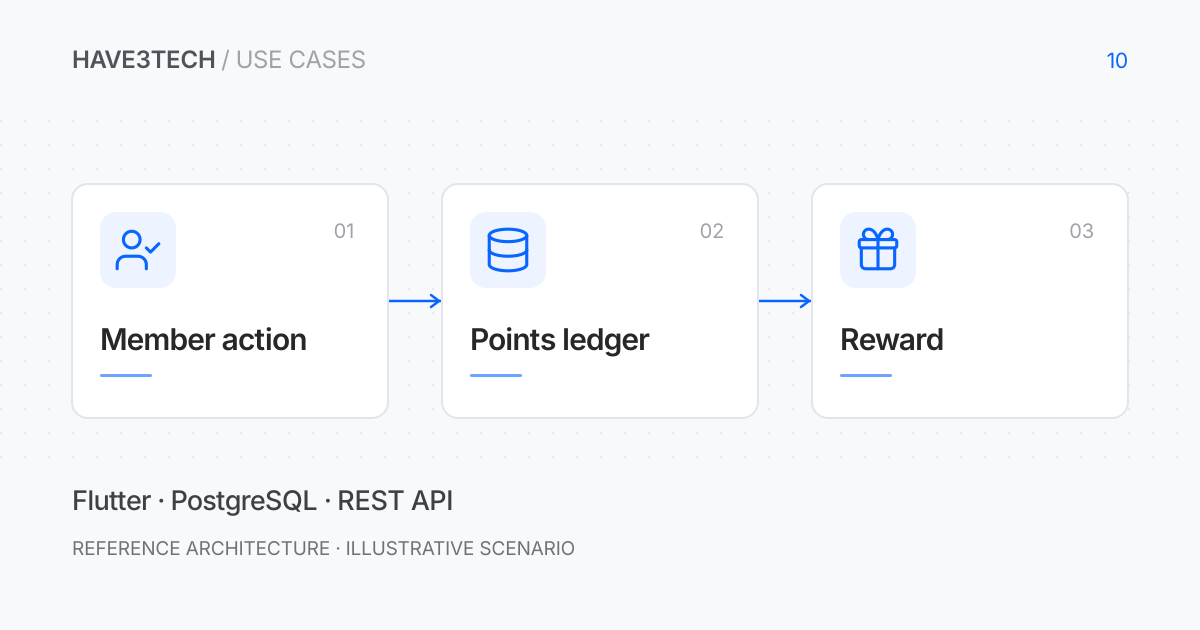
The initial release could cover joining one programme, earning points from an approved source, viewing a balance, and redeeming one reward type. The product specification would define eligibility, expiry, and cancellation behaviour in plain language. Staff approval and member access would be separate permissions.
Flutter would present the member journey, while the API would remain authoritative for eligibility and balances. A short feedback loop would examine whether people understand the rules and complete redemption. Interface wording and programme mechanics could be adjusted before investing in more automation.
Record why a balance changed
An append-only ledger would record earning, redemption, expiry, and reversal entries with their source references and rule versions. A source event identity would prevent a repeated qualifying action from earning points twice. Correcting a mistake would create a linked adjustment rather than erase the original history.
A redemption transaction would validate available points and reserve or consume the reward atomically. PostgreSQL concurrency control, appropriate locks or isolation, and retry handling would protect that rule under simultaneous requests. A cached balance on the phone would be a display snapshot, never authority to approve spending.
Make reward fulfilment recoverable
The API would return a stable redemption identity and current status. If a member retries after losing connectivity, the same request identity would recover the existing outcome. An external fulfilment step would have a pending state and a defined compensation path if the reward cannot be issued.
A pilot dashboard would distinguish points earned, reward requested, reward fulfilled, and reward reversed. These events would help identify a confusing step without treating a points balance as money or promising a revenue uplift. Member-facing history would explain changes, including delayed confirmation and a corrected transaction.
What to validate
- A repeated source event earns points once.
- Concurrent redemptions cannot overspend the available balance.
- A lost response can be recovered through the same redemption identity.
- A reversal and failed fulfilment remain understandable in member history.
The tradeoff
A loyalty MVP combines product rules, transactional data, and operational follow-through. A narrow programme with clear rules is easier to learn from than a broad platform whose points and reward states cannot be explained.
Technical references
Official documentation supporting the tools and mechanisms discussed above. The proposed architecture is illustrative.