The scenario
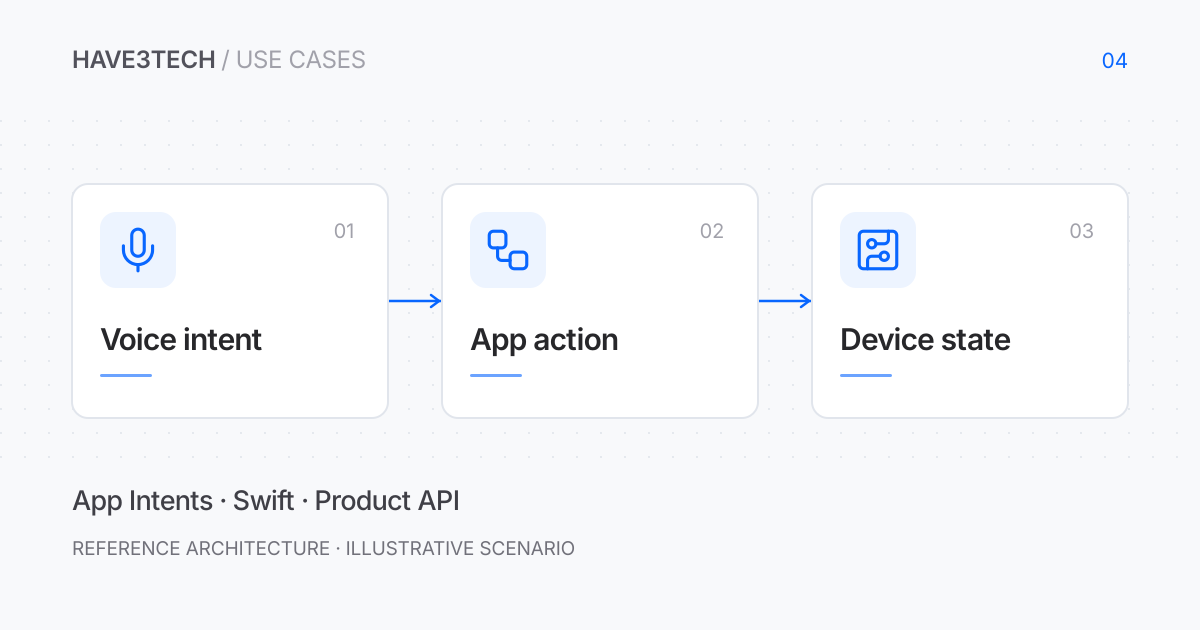
Imagine a connected display product whose owner wants to activate a saved scene through a voice shortcut. The same action already exists inside the mobile app. The reference design would expose that specific capability through a structured intent, while reusing the product’s validation and command handling instead of creating a second unrestricted control channel.
Define a small, explicit action vocabulary
An intent could accept a known device and saved scene. Those values would resolve to application entities rather than arbitrary command strings. Friendly names would help selection, but stable internal references would identify the selected objects after a rename.
The product would decide which actions are appropriate for a shortcut and which should open the app for further review. App Intents supplies the integration surface for supported system experiences; it does not decide the product’s authorization or safety policy. This example would begin with a reversible display-scene change.
Reuse the same command path as the application
The intent handler would invoke a shared application action that resolves the current account, ownership, and scene availability. The backend would check permission again before issuing a device command. A shortcut configured yesterday would not remain authorized after the person loses access to that device.
A request identity would distinguish an intentional repeated action from a retried delivery. The service would separate command accepted from device confirmed, especially when a connected device is offline. The spoken or visible result would reflect that distinction rather than reporting success immediately after an HTTP request is queued.
Make ambiguity and interruption understandable
Two devices with the same display name would require disambiguation. Missing credentials, an unavailable scene, or required authentication would produce a useful next step. The product would choose whether the action can proceed while locked using the platform’s supported authentication controls and its own risk model.
Tests would exercise renamed devices, expired sessions, offline hardware, and interruption while the action is running. Localized phrases and responses would be reviewed alongside the app’s terminology. Logs would identify the intent type and outcome without storing a voice recording or unnecessary personal content.
What to validate
- The shortcut invokes the same validated action as the app.
- Revoked device access prevents an old shortcut from executing.
- Accepted and confirmed commands receive different responses.
- Ambiguous entities, required authentication, and offline devices have usable outcomes.
The tradeoff
Voice is convenient for a small number of clear actions. Complex configuration belongs in a richer interface, and support for Siri or Shortcuts does not imply that the same intent implementation works across other voice-assistant platforms.
Technical references
Official documentation supporting the tools and mechanisms discussed above. The proposed architecture is illustrative.