The scenario
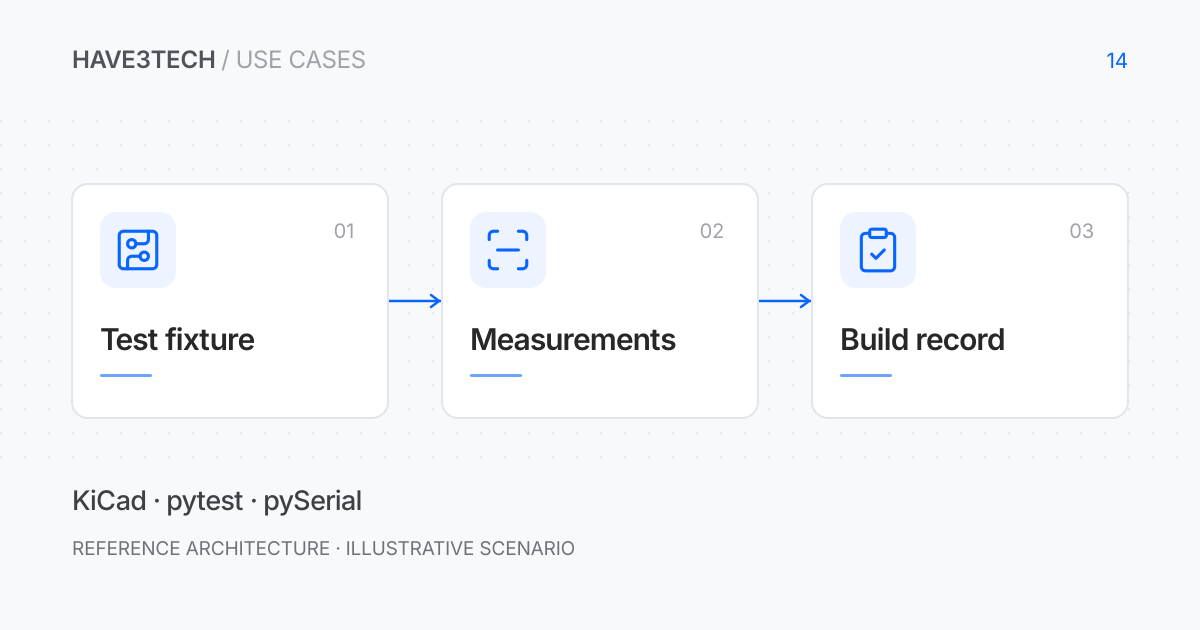
A fictional hardware product is moving from hand-checked prototypes to a small repeatable assembly run. An operator needs a clear pass, fail, or incomplete result with evidence. This example would establish a fixture interface and a versioned test procedure without assuming that a final green indicator proves every aspect of product quality.
Plan the fixture while designing the board
The PCB would expose accessible test points for the required supply rails, programming interface, and selected signals. The fixture design would account for board orientation, mechanical support, contact wear, and limits on how the assembly can be powered.
A test specification would define which measurements are meaningful for each board revision. Instrument tolerances and acceptance limits would be reviewed together. A measurement just inside a threshold should not silently become a different rule when the fixture or instrument changes.
Make the test runner leave a known state
A Python runner could use pytest fixtures to prepare instruments, open the board connection, and release resources after each run. pySerial communication would use explicit timeouts so that an unplugged or unresponsive board cannot block the station indefinitely.
The procedure would separate station checks from board checks. A missing instrument, failed self-test, or unstable contact would produce an incomplete run rather than an ordinary product failure. Power and programming steps would stop safely if a prerequisite fails.
Keep evidence for each test attempt
Each run would record a board reference, hardware revision, firmware image, fixture version, test-software version, measurements, and final state. Raw observations would remain distinguishable from the decision calculated from them. A retest would create a new attempt linked to the previous one.
Known-good and deliberately faulty reference units would help evaluate whether the station detects the faults it is meant to find. The operator interface would show the current step and a specific reason for interruption, with a controlled process for investigating repeated failures.
What to validate
- The runner times out cleanly when the board is disconnected.
- A station fault is distinguishable from a board fault.
- A retest preserves the original result and measurement evidence.
- The result identifies the test and hardware revisions used.
The tradeoff
A fixture detects only the failure modes covered by its design and limits. Test coverage, calibration, contact reliability, and process reviews remain necessary; adding more automated steps is useful only when they reveal meaningful defects.
Technical references
Official documentation supporting the tools and mechanisms discussed above. The proposed architecture is illustrative.