The scenario
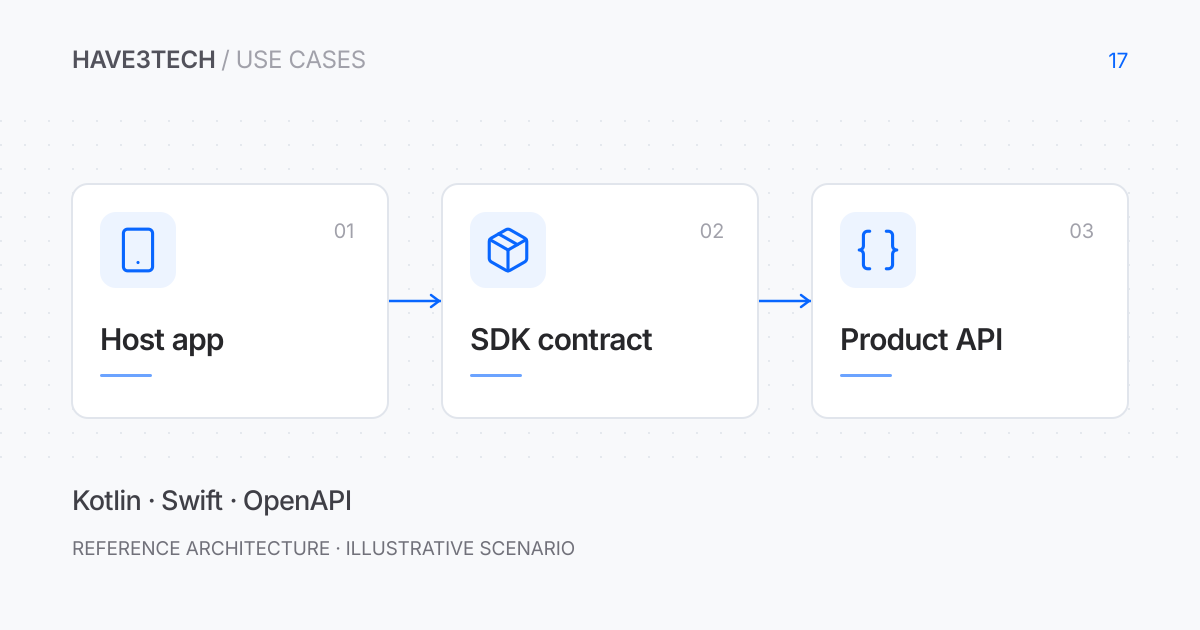
Imagine a product exposing a small SDK so other mobile applications can integrate selected functionality. The host app already has its own navigation, authentication, dependency versions, and release schedule. This example would create an integration boundary that is predictable for application developers and maintainable across SDK releases.
Start with the integration experience
The public API would expose product operations rather than internal service objects. A short example application would demonstrate setup, one successful operation, cancellation, and a recoverable error. The host would remain in control of its interface and application lifecycle.
Authentication would use an agreed short-lived or delegated credential flow. A mobile SDK would not contain a private backend service credential. Diagnostics would avoid recording tokens, and any optional telemetry would have a documented contract instead of arriving as an unexpected integration side effect.
Share the contract without ignoring platform differences
OpenAPI could describe the HTTP boundary, including error responses and optional fields. Generated transport code could help maintain consistency, while a small hand-designed SDK layer would provide a natural Kotlin or Swift interface. Changes to generated code would be reviewed as public behaviour changes.
The SDK would specify how asynchronous operations are cancelled and what happens if the host app loses its session or moves to the background. Retries would be limited to operations whose semantics allow them. Typed errors would distinguish authentication, validation, connectivity, and service failure.
Test the SDK as a consumer would use it
Compatibility checks would distinguish source, binary, and behavioural compatibility. A version bump alone would not prove that an existing host still works. The release pipeline would build sample hosts against supported toolchains and exercise a small contract test suite.
A change log would explain altered behaviour, migration steps, and deprecation periods. The SDK would keep its dependency surface small and allow the host to understand timeouts and resource usage. A previous supported release would remain available while consumers schedule their upgrades.
What to validate
- A sample host integrates without depending on private SDK types.
- Cancellation and authentication expiry produce documented outcomes.
- A repeated call follows the operation’s retry semantics.
- Supported consumer builds and contract tests pass before release.
The tradeoff
An SDK creates an ongoing compatibility commitment. A well-documented HTTP API may be enough when consumers need only a few operations. Native SDKs become more useful when they remove recurring platform-specific integration work.
Technical references
Official documentation supporting the tools and mechanisms discussed above. The proposed architecture is illustrative.