The scenario
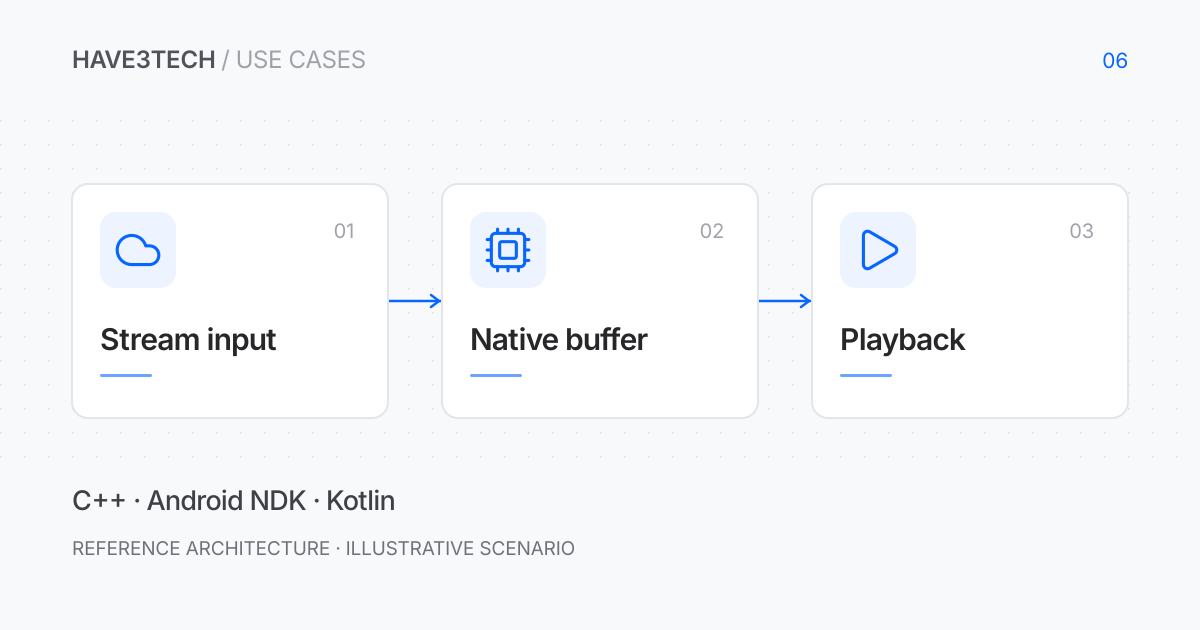
Imagine an Android app with an existing C++ streaming engine. Some sessions start slowly or stall after connectivity changes, but replacing the engine would be expensive. This reference investigation would first identify where time and memory are spent, then change one measurable bottleneck while keeping playback controls and recovery predictable. It makes no claim of a particular performance improvement.
Separate startup delay from sustained playback problems
A trace would mark request start, first bytes, decoder readiness, first rendered output, and each rebuffer interval. A controlled stream fixture would make runs comparable. The test matrix would include a fast connection, variable throughput, short interruptions, and an application moving between foreground and background.
The team would inspect queue depth, allocation volume, thread scheduling, and time spent crossing the native boundary. The goal would be an explanation for the observed delay, rather than a general assumption that C++ is faster or that increasing every buffer will fix stalling.
Give buffers and threads clear ownership
Each pipeline stage would define who owns an input block, when it can be reused, and what happens when downstream work is slower. Bounded queues would prevent an interrupted consumer from consuming memory indefinitely. The product would choose a backpressure or discard policy appropriate to its stream semantics.
The JNI boundary would expose a small control API and batch useful data rather than repeatedly marshalling tiny objects. Native handles would have explicit lifetimes. A cancellation sequence would stop producers, wake waiting consumers, and release resources in a defined order before the app creates a new session.
Validate the change across the whole playback lifecycle
A candidate improvement would be compared with the baseline on the same fixtures and devices. Startup latency, rebuffer time, memory, and battery impact could move in different directions. A buffer change that helps a local test might make live playback too far behind, so the accepted tradeoff would be recorded.
Repeated start, pause, seek where supported, stop, and reconnect operations would be exercised alongside longer sessions. Error handling would preserve a useful UI when native initialization fails. Rollout would retain the ability to switch back to the previous engine build while collecting bounded diagnostic summaries.
What to validate
- A repeatable trace identifies the stage responsible for delay.
- Queue bounds hold when the consumer stops or connectivity changes.
- Repeated cancellation does not leak native handles or leave blocked threads.
- The comparison includes latency, memory, stability, and longer-session behaviour.
The tradeoff
Native optimization can improve a measured bottleneck, but adds ownership and interoperability risks. Fixing an application scheduling or network problem may be more valuable than changing the codec or moving more code into C++.
Technical references
Official documentation supporting the tools and mechanisms discussed above. The proposed architecture is illustrative.