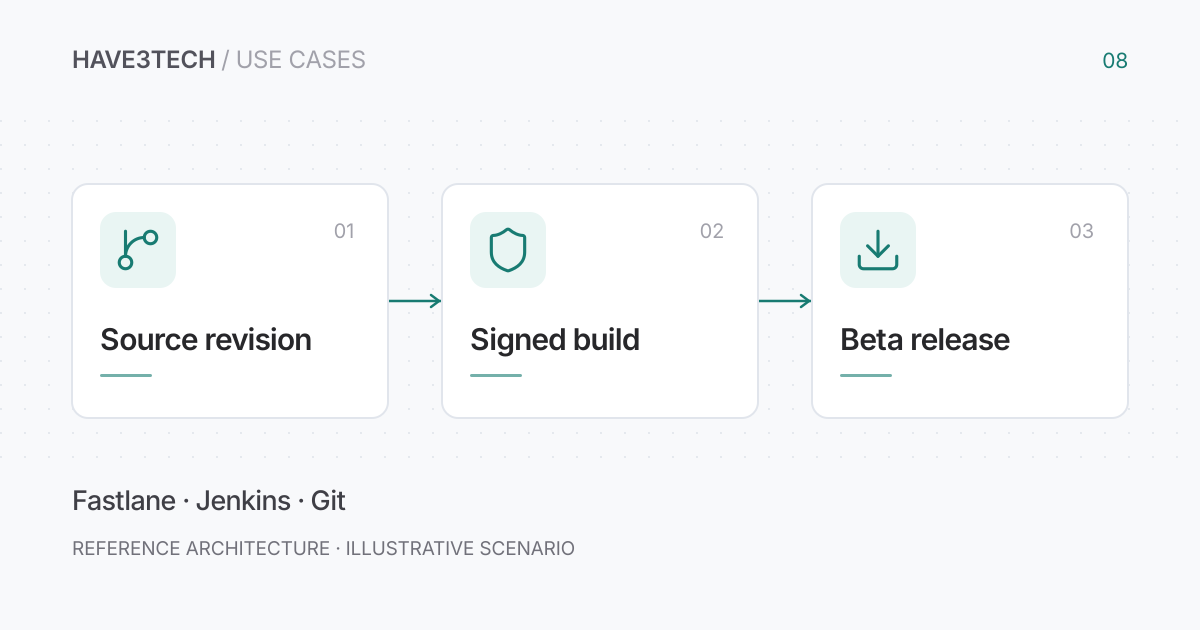
The scenario
Imagine a small team maintaining native Android and iOS apps. Release preparation depends on one developer’s laptop, and a beta cannot easily be traced back to its source and configuration. This example would turn those steps into an inspectable pipeline with explicit signing access and a deliberate boundary between preparing an artifact and making it available to customers.
Record the inputs to every candidate
A release manifest would identify the source revision, dependency locks, app version, build number, environment, and selected toolchain. Android and iOS jobs would use suitable workers and supported SDK installations. The team would decide how to refresh those workers without silently changing an active release candidate.
Ordinary verification would run without production signing access. A failed type check, unit test, or required integration check would stop promotion. Build numbers would be allocated through one authoritative mechanism so retried jobs cannot accidentally reuse an incompatible store upload identity.
Keep signing and distribution behind explicit stages
Fastlane lanes would define the platform build and beta-distribution steps, while a versioned Jenkinsfile would describe their orchestration. Signing material and store credentials would come from the approved credential system at runtime. They would not be embedded in source, printed in command traces, or available to untrusted change builds.
A candidate record would include artifact checksums and the destination track. A protected release stage would show the exact revision and intended distribution action. Platform-specific packaging could require separate signed outputs; the pipeline would preserve the relationship between them rather than claiming all store uploads are bit-identical.
Treat store acceptance as a separate outcome
A beta upload would produce a traceable delivery receipt and a clear status for later processing. Upload success would not mean that review finished or that production users received the app. The release view would keep build, upload, processing, review, and rollout states separate.
Recovery would first inspect whether an upload already succeeded before repeating it. A rollout problem might require pausing distribution or shipping a corrective version, because a published mobile binary cannot simply be replaced on every device. The runbook would document these platform constraints and keep release notes linked to the candidate.
What to validate
- Every beta can be traced to a source revision, toolchain, and configuration.
- Untrusted change builds cannot access release credentials.
- A retried upload does not silently produce a different candidate.
- Upload, review, and rollout statuses are visible independently.
The tradeoff
Automation reduces repeated manual steps, but the signing and store lifecycle still require ownership. A modest pipeline that the team can repair is preferable to a complex release system with no maintained runbook.
Technical references
Official documentation supporting the tools and mechanisms discussed above. The proposed architecture is illustrative.