The scenario
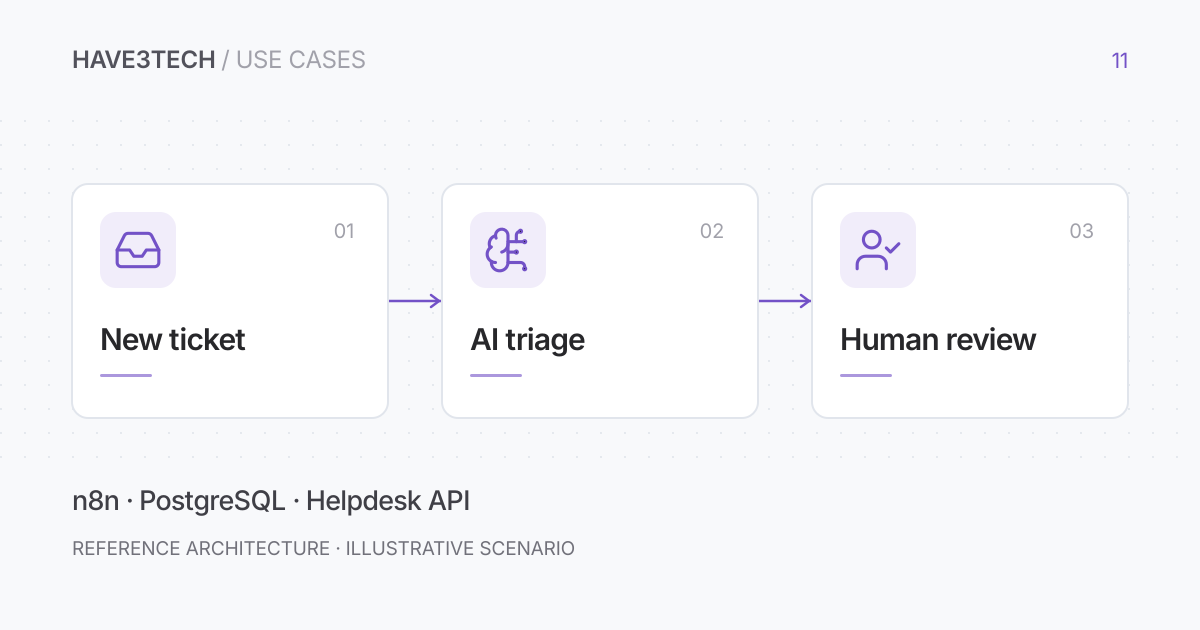
Consider a small software product receiving installation questions, account issues, and bug reports through one support inbox. An illustrative automation would suggest a category, retrieve the relevant help article, and prepare an internal response draft. A support engineer would remain responsible for the message sent to the customer.
Make intake repeatable before adding a model
A helpdesk webhook would enter an n8n workflow through an authenticated endpoint. The first step would validate the expected fields and store the provider’s ticket and event identifiers. A uniqueness constraint would prevent a repeated delivery from creating a second classification job.
Attachments and long conversation histories would need a deliberate policy. The initial version could use only the latest text message and selected product metadata, excluding secrets and unnecessary customer details. Invalid requests would go to a diagnostic queue with a reason, rather than silently disappearing.
Ask for a bounded suggestion
The model would return a structured category, urgency suggestion, and draft. The allowed categories would come from a fixed schema. An application step would validate this output and route missing or unsupported categories to a general review queue.
The model would not get a general-purpose helpdesk credential. A narrow tool could propose a ticket update, while n8n’s human review mechanism could gate execution of that tool. The reviewer would see the exact intended action and draft before approving or rejecting it. Approval of one ticket would not authorize future tickets.
Design the failure path as part of the workflow
A timeout, unavailable model, or failed validation would leave the ticket in a manual queue. Retries would reuse the same event identity and stop after a bounded number of attempts. A delayed retry would check whether a human had already answered before preparing a new draft.
Store the workflow version, review decision, and final action status separately. This would make it possible to identify recurring classification errors without treating a model’s own confidence score as measured accuracy. Start in draft-only mode and evaluate the suggestions against real support expectations before allowing approved updates.
What to validate
- Repeated webhooks create one work item.
- A rejected draft cannot be sent by a later retry.
- Model failure leaves the normal support process usable.
- The review record identifies the exact approved action.
The tradeoff
A visual workflow is quick to inspect, but complex branching can become difficult to maintain. Keep classification, persistence, and helpdesk writes as small, explicit steps; move heavily reused logic into a versioned service when needed.
Technical references
Official documentation supporting the tools and mechanisms discussed above. The proposed architecture is illustrative.